From Firefighting to Future-Building: The Ultimate Guide to Nonprofit Strategy
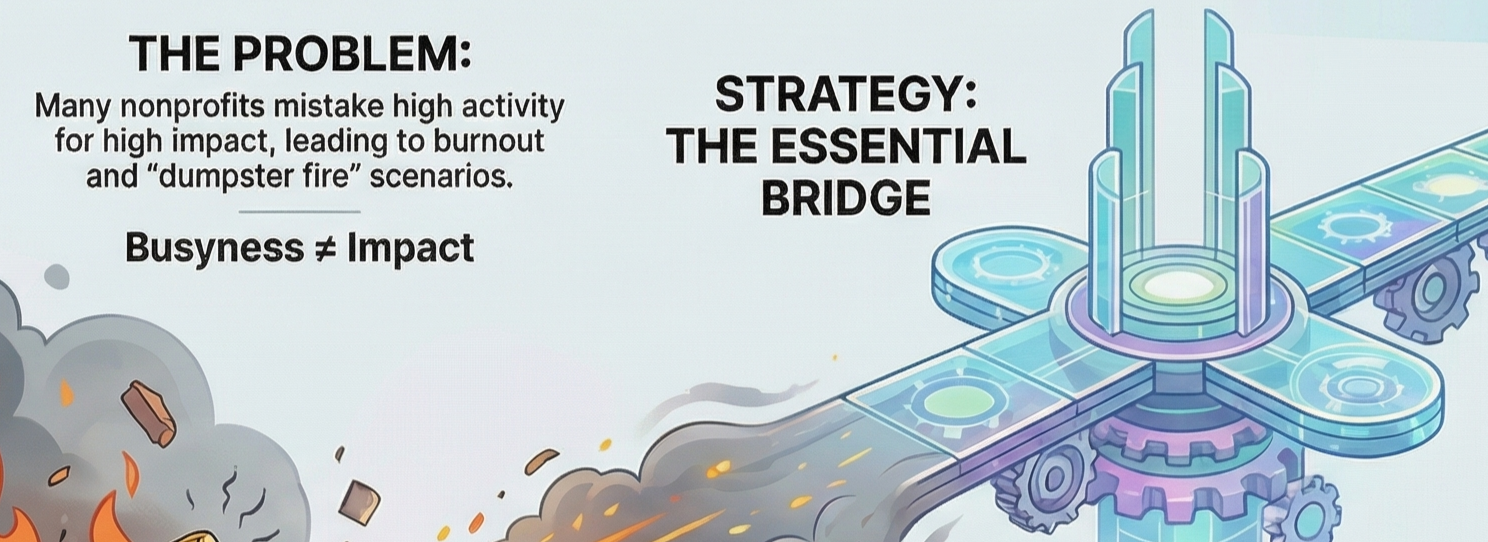
In the nonprofit sector, we often wear our busyness as a badge of honor. We measure our success by the length of our to-do lists, the number of emails in our inbox, and the speed at which we can extinguish the "fire of the day." But there is a dangerous trap in this hustle: activity is not the same as impact.
Sometimes I wonder if I should just change my consulting firm name to Dumpster Fire Consulting because that’s what I’ve seen since the pandemic. Nobody wants to admit that they have a dumpster fire situation, but I see it every day with tension between nonprofit boards & directors, staff members burned out and exploding in the workplace, and organizations without any fundraising plans because they fully relied upon government funding.
In this month’s newsletter, I am discussing strategy because it’s something that we ALL need to learn and practice. The fastest way to a dumpster fire is living in tactical space – the long to-do list without ever pulling up to see what’s ahead. Strategy is a key leadership skill, and it can be taught. Here’s how.
Strategy is the Roadmap
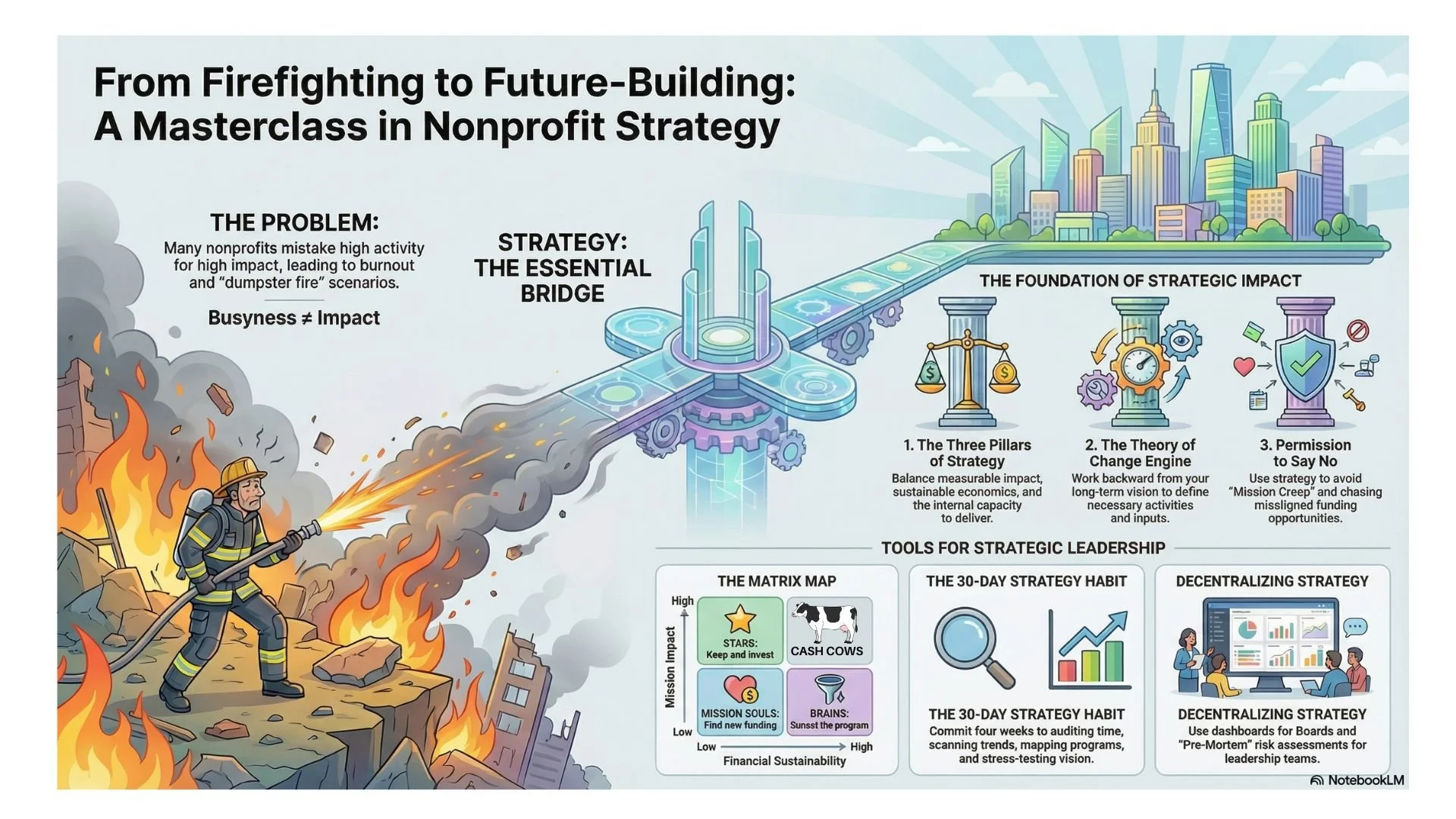
At its simplest, nonprofit strategy is the bridge between your mission (the change you want to see) and your daily operations (the work you actually do).
In the for-profit world, strategy is often about beating the competition to maximize profit. In the nonprofit world, strategy is about maximizing social return. It is the art of making choices—specifically, choosing how to allocate limited resources (time, money, and talent) to achieve the greatest possible impact. Example: a food pantry trying to serve more people while also advocating for government policies that decrease food insecurity.
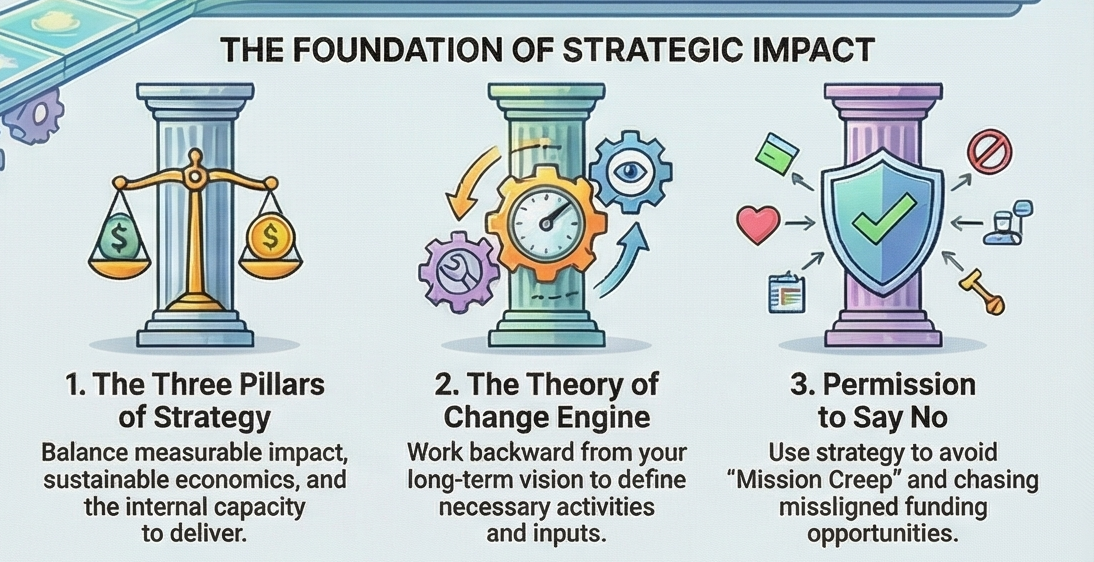
A robust nonprofit strategy rests on three pillars:
Impact: What specific, measurable change are we aiming for? (Ex. Serving more people, decreasing people experiencing homelessness, etc.)
Economics: How do we fund this work sustainably without losing our soul? (Ex. Donors that align with your mission, internal policies reflect external messaging, etc.)
Capacity: Do we have the infrastructure and people to actually deliver? (Ex. Paying living wages, safety procedures, etc.)
Without strategy, organizations fall victim to Mission Creep. This happens when a nonprofit says "yes" to every grant and every new idea, eventually becoming a "jack of all trades and master of none." Strategy gives you the "permission to say no" to things that don’t align with your North Star. I can’t tell you how often I see organizations chasing money without a long-term strategy. It’s exhausting.
From Roadmap to Engine
If strategy is the roadmap, the Theory of Change is the engine. It is a logical "if-then" chain that maps out how your specific actions lead to your ultimate goal. Unlike a simple plan, a theory of change starts at the end and works backward.
The Five Building Blocks:
Inputs: What you invest (Funding, staff, volunteers).
Activities: What you do (Classes, counseling, advocacy).
Outputs: The immediate numbers (Number of people served, hours taught).
Outcomes: The actual change (Increased literacy, improved health).
Impact: The long-term vision (Ending poverty, healthy ecosystems).
The most critical—and often ignored—part of a ToC is the Assumptions. For example, if your activity is "providing job training," your assumption is that "there are jobs available for these people." Strategic leaders constantly test their assumptions to ensure their logic hasn't become a "wish list."
This is a critical part of the organization design AND strategic planning. Often, I see clients falter in strategic planning because they don’t have a clear theory of change. And a theory of change can be updated – that’s part of your organization lifecycle. Here’s an example for a local food pantry:
Inputs: What you invest (Funding, staff, volunteers, food supply)
Activities: What you do (provide 80 pounds of food per household bi-weekly).
Outputs: The immediate numbers (Number of people served, communities reached).
Outcomes: The actual change (decreased hunger, increased economic security).
Impact: The long-term vision (filling the gap of food insecurity in our region).
Building the Strategic Leader
Strategic thinking is a muscle, not a talent you’re born with. If you find yourself stuck in "tactical mode," you must intentionally build new habits. Here are a few that you can try:
1. Shift from Micro to Macro
Stop looking only at your internal data. Start "Horizon Scanning." What are the political, economic, and social trends happening outside your office? A strategic leader understands the ecosystem, not just their organization.
Example: A food pantry loses access to free food from the federal government. The micro action is wondering how to fill the gap now, and the macro action is exploring how long this access gap may last and how you will handle it.
2. Master the "Matrix Map"
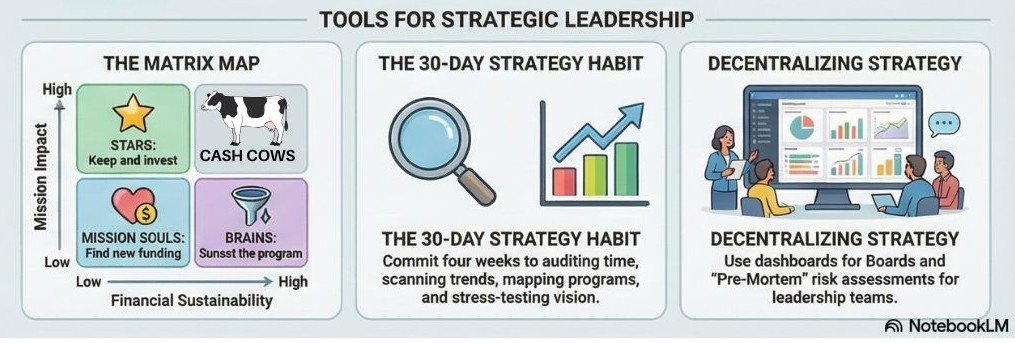
Strategic leaders connect mission to money. Use a Matrix Map to plot your programs on two axes: Mission Impact and Financial Sustainability.
Stars: High impact, high sustainability. (Keep doing these!)
Mission Souls: High impact, low sustainability. (Find ways to fund these!)
Cash Cows: Low impact, high sustainability. (Use these to fund the souls!)
Drains: Low impact, low sustainability. (It’s time to sunset these.)
Note: This looks WAY easier on paper. It’s hard to cut programs that volunteers love. I encourage you to involve stakeholders in conversations about these opportunities.
3. The 30-Day Strategy Habit
Commit to a 30-day "Strategy Habit" plan:
Week 1: Audit your time and create a "No" list.
Week 2: Scan the horizon for external trends.
Week 3: Map your programs using the Matrix Map.
Week 4: Stress-test your vision with a "Strategic Coffee" with a peer or mentor.
Example: A “no” list may include attending a meeting less often or unsubscribing from an email that no longer serves. Less stimulus = equal more strategic thinking.
Scaling Up With Your Team
The Executive Director cannot be the only strategic thinker in the building. To truly scale impact, strategy must be decentralized.
For the Leadership Team:
Move your team from "Department Heads" to "Organizational Owners."
The 50/50 Meeting: Half the meeting for tactics, half for one deep strategic question. Example: What’s working really well right now? What lessons can we learn and deploy elsewhere in the organization?
The Pre-Mortem: Before a launch, ask: "Imagine it’s a year from now and this failed. What went wrong?" This trains the team to see risks before they become disasters. Note: I’d also recommend a post-mortem after every big event or project.
For the Board of Directors:
The Board is your strategic partner, but only if you lead them there.
The Generative Flip: Don't spend the whole meeting reading reports. Assume they've read the board packet and spend the first 45 minutes on "Generative Thinking"—asking the "big why" questions. Note: This transition will take time as people get used to the change. Give people 3-4 meetings to change behavior.
Strategic Dashboards: Give them a one-page visual that shows trends in Impact, Cash Reserves, and Reputation. If you give them a 20-page spreadsheet, they will look for typos. If you give them a dashboard, they will look for solutions. Note: This is my favorite intervention. Here’s an example: Planning Template.
Develop a Personal Board of Directors
As a leader, there is no "Principal’s Office." You are your own boss, which makes it easy to slide back into firefighting. You need to find people who will help you with pulling up to strategic thinking and not living in tactical mode. Most often people call this a “personal board of directors.” Here are some ways to help with this process.
Color-Code Your Calendar: If your "Green" (Strategic) time is less than 20%, you are at risk of burnout and organizational stagnation. Note: If you use Google Calendar and color code your day, it will analyze your time for you.
Build a "Think Day": Schedule one day a month out of the office. No email. No Slack. Just you, a notebook, and your Theory of Change. Note: I like to walk outside, take notes, and discuss with a friend in the afternoon.
Join a Mastermind: Find 2–3 other Executive Directors. Meet monthly to present a "Strategic Dilemma." They will see your blind spots far better than you can. Note: Highly recommend these two resources - Mastermind Leadership Cohort with Patton McDowell (virtual) and REACH groups through the Reach Women’s Network (Winston-Salem, NC).
Strategy is not a document that sits on a shelf or something that requires a big degree; it is a way of being. It is the commitment to stop being busy and start being effective. It is the courage to say "no" to a good opportunity so you can say "yes" to a great one.
The world’s problems are too urgent for us to be disorganized. By building your strategic skills, you aren't just managing an organization better—you are honoring the mission you set out to achieve.
Wanna read more? Here are some strategic thinkers that I follow. What you’ll find with each of these reads is that strategic thinking requires time, reflection, and discipline.
Nic Gagliardi, The Nonprofit Governance Nerd
Rebecca White, The Pocket COO - The External Strategy You Might Miss as a New Executive Director
Tina Krall, Fundraising Reconstructed - Stop Waiting for the Fundraising Budget Number. Build It.
Access free resources. These include How to Start a Strategic Planning Process (blog post), strategic dashboard template, Gemini AI prompts for creating a Theory of Change, and plans for skill building with leaders and teams.
Need a little boost to get started? Book a free 30-minute coaching call with me. No sales pitches. No commitment. Just free time to think out your next steps.